- ++8801924981649
- [email protected]
- Navana Barek Carmela, Baro Moghbazar

Basic HVAC Systems Research Paper: 5 Key Insights Explained
1. What Is HVAC ?
HVAC stands for Heating, Ventilation, and Air Conditioning. It is the technology of indoor and vehicular environmental comfort. While often taken for granted, HVAC systems are complex engineering marvels that govern the thermodynamics of our living and working spaces.
The primary goal of an HVAC system is not merely to change temperature, but to regulate four fundamental parameters:
- Dry-bulb Temperature: The thermal state of the air.
- Humidity: The moisture content (water vapor) in the air.
- Air Velocity: The draft or movement of air to prevent stagnation.
- Air Quality: The cleanliness of the air (filtration of particulates and dilution of gases).
Whether in a small bedroom or a massive industrial plant, the underlying physics remains the same: the Second Law of Thermodynamics. Heat naturally flows from a hot body to a cold body. To cool a room, we must perform work to move heat against this natural gradient—moving it from a cool room to the hot outdoors.
2. The Physics of Cooling: The Vapor-Compression Cycle
Almost all modern air conditioning systems, from window units to massive industrial chillers, rely on the Vapor-Compression Refrigeration Cycle. This is the “engine” of the HVAC world.
To understand this, we must understand the behaviour of the refrigerant—a fluid with thermodynamic properties that allow it to boil (absorb heat) and condense (release heat) at convenient temperatures.
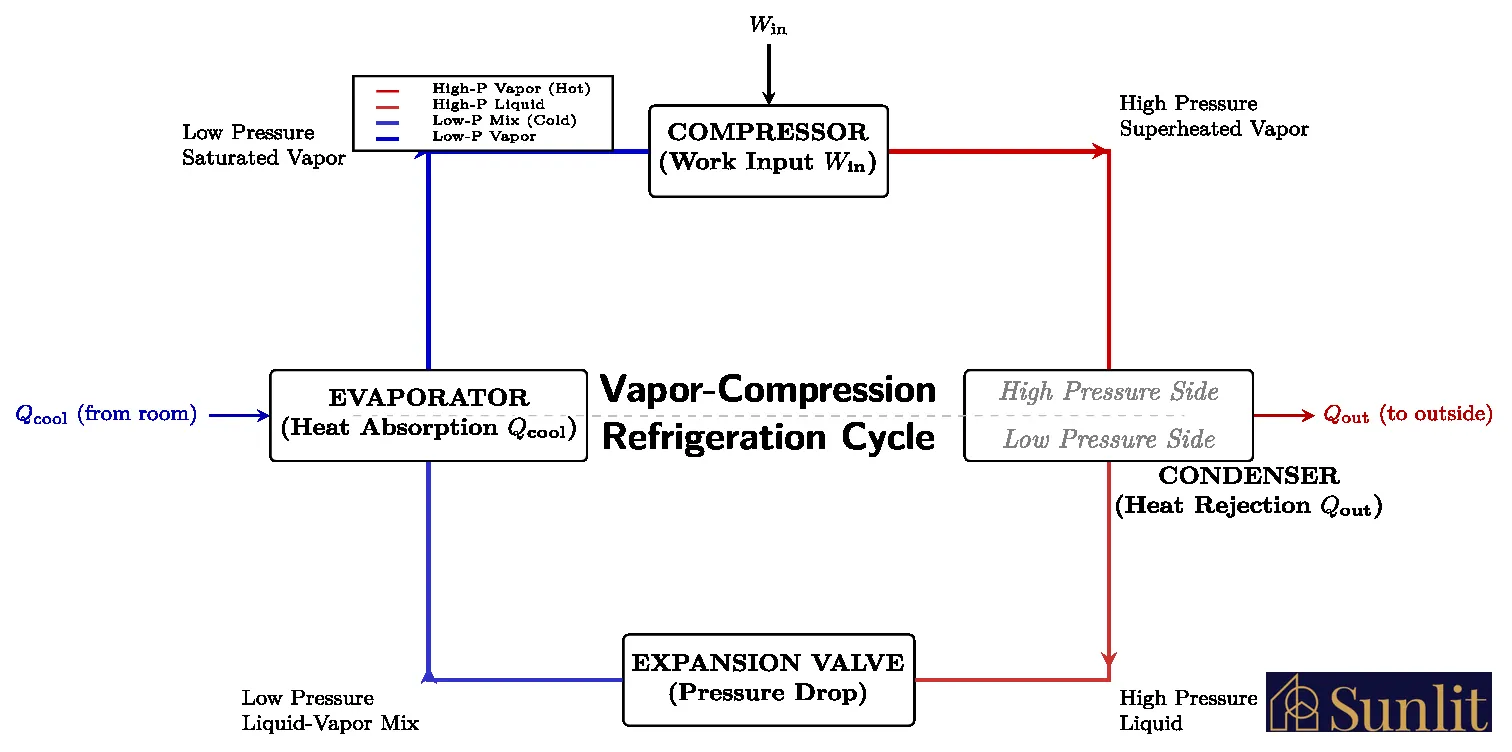
The cycle consists of four distinct stages:
- Compression (The Heart): The compressor pumps low-pressure, low-temperature refrigerant vapor and compresses it. According to the Ideal Gas Law ($PV = nRT$), increasing pressure ($P$) increases temperature ($T$). The refrigerant leaves the compressor as a high-pressure, superheated gas. $$ W_{\text{in}} = \dot{m} (h_2 – h_1) $$ Where $W_{\text{in}}$ is the work done by the compressor, $\dot{m}$ is mass flow rate, and $h$ is enthalpy.
- Condensation (Heat Rejection): This hot gas flows into the condenser coil (usually located outside). A fan blows outside air over the coil. Since the gas is hotter than the outside air, heat transfers from the refrigerant to the air. The refrigerant condenses from a gas into a high-pressure liquid.
- Expansion (The Throttle): The liquid refrigerant passes through an expansion valve (or capillary tube). This is a restriction that drastically drops the pressure. When pressure drops, the temperature drops instantly (flash evaporation). The fluid becomes a low-pressure, cold liquid-vapor mixture.
- Evaporation (Heat Absorption): This cold mixture enters the evaporator coil (located inside the room). Warm indoor air is blown over these cold coils. The refrigerant absorbs the heat from the room air and boils (evaporates) completely into a gas. The air, having lost its energy to the refrigerant, is blown back into the room as cold air. $$ Q_{\text{cool}} = \dot{m} (h_1 – h_4) $$ Where $Q_{\text{cool}}$ is the cooling capacity.
3. Residential HVAC Systems
In residential settings, the priority is comfort, low noise, and simplicity.
3.1 The Split System (Direct Expansion – DX)
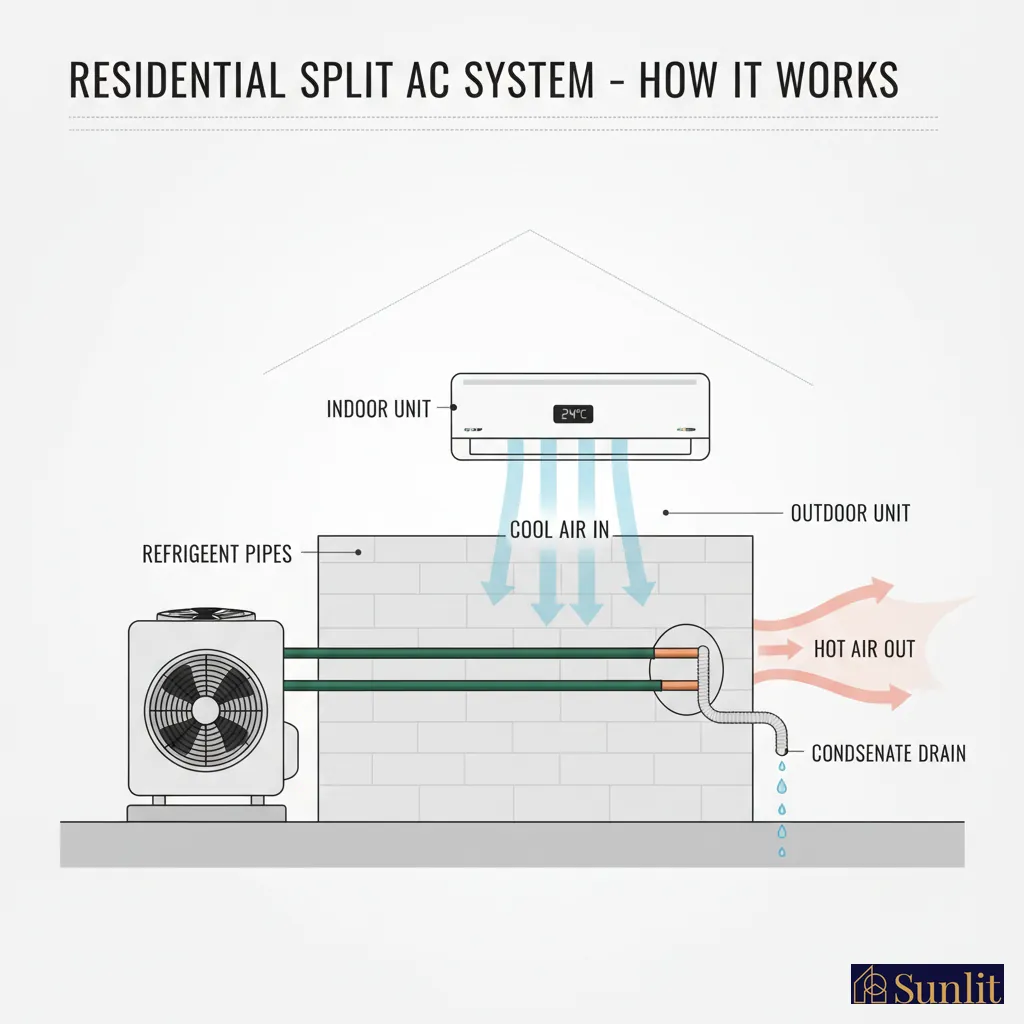
The most common system in modern homes is the “Split System.” It is called “split” because the components are separated into two units:
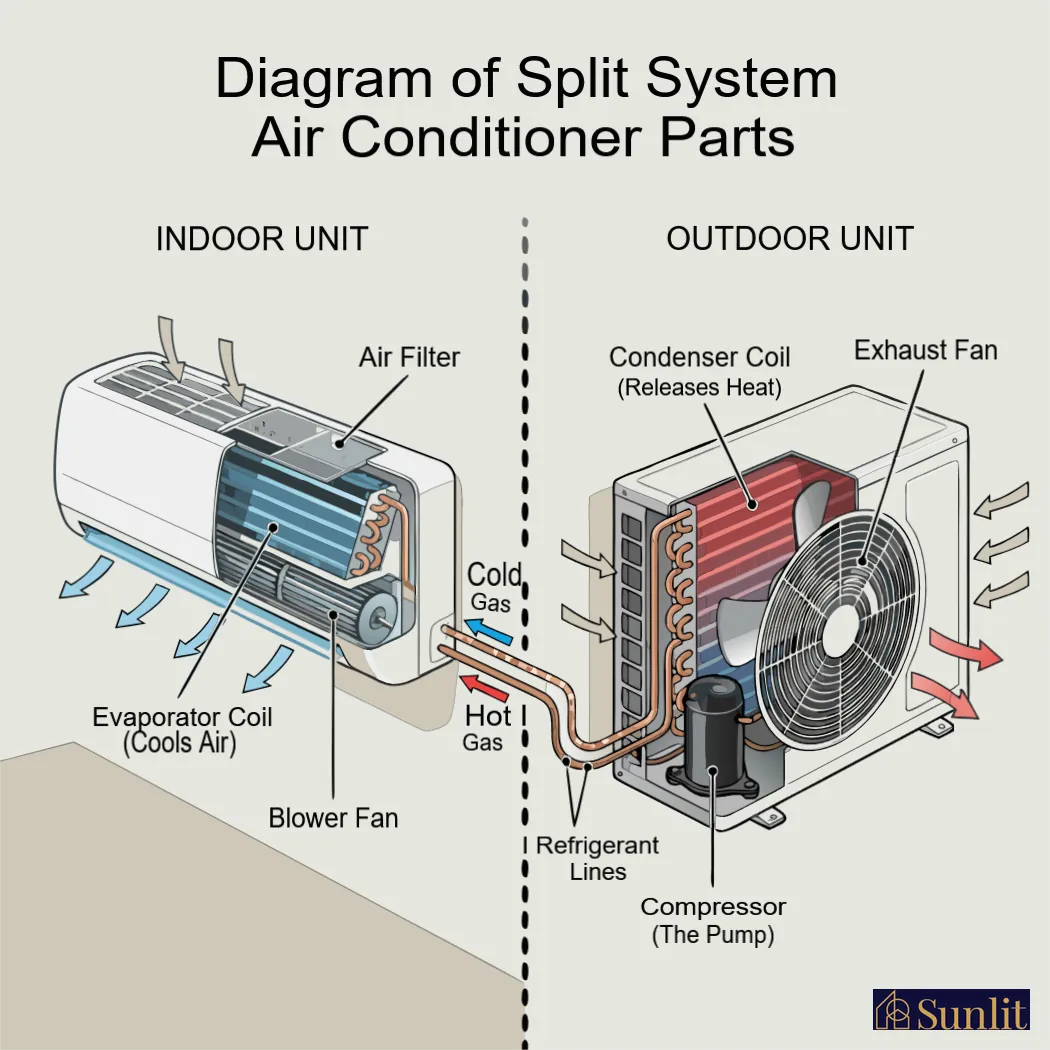
- Outdoor Unit: Contains the compressor and condenser.
- Indoor Unit: Contains the evaporator and the expansion valve (usually).
How it works:
Copper tubing connects the two units. The refrigerant flows directly to the indoor unit to cool the air. This is known as a Direct Expansion (DX) system.
3.2 Dehumidification
An often overlooked function of the residential AC is dehumidification. When warm, humid air hits the cold evaporator coil (which is below the dew point temperature), moisture in the air condenses into water droplets on the coil—just like a cold soda can “sweats” on a hot day. This water is collected in a pan and drained away. This process lowers the indoor relative humidity.
4. Commercial HVAC Systems (Offices, Malls, Hotels)
As buildings get larger, running copper refrigerant lines to every room becomes inefficient and technically impossible (due to pressure drops). Commercial systems use different heat transfer mediums.
4.1 The Chiller System
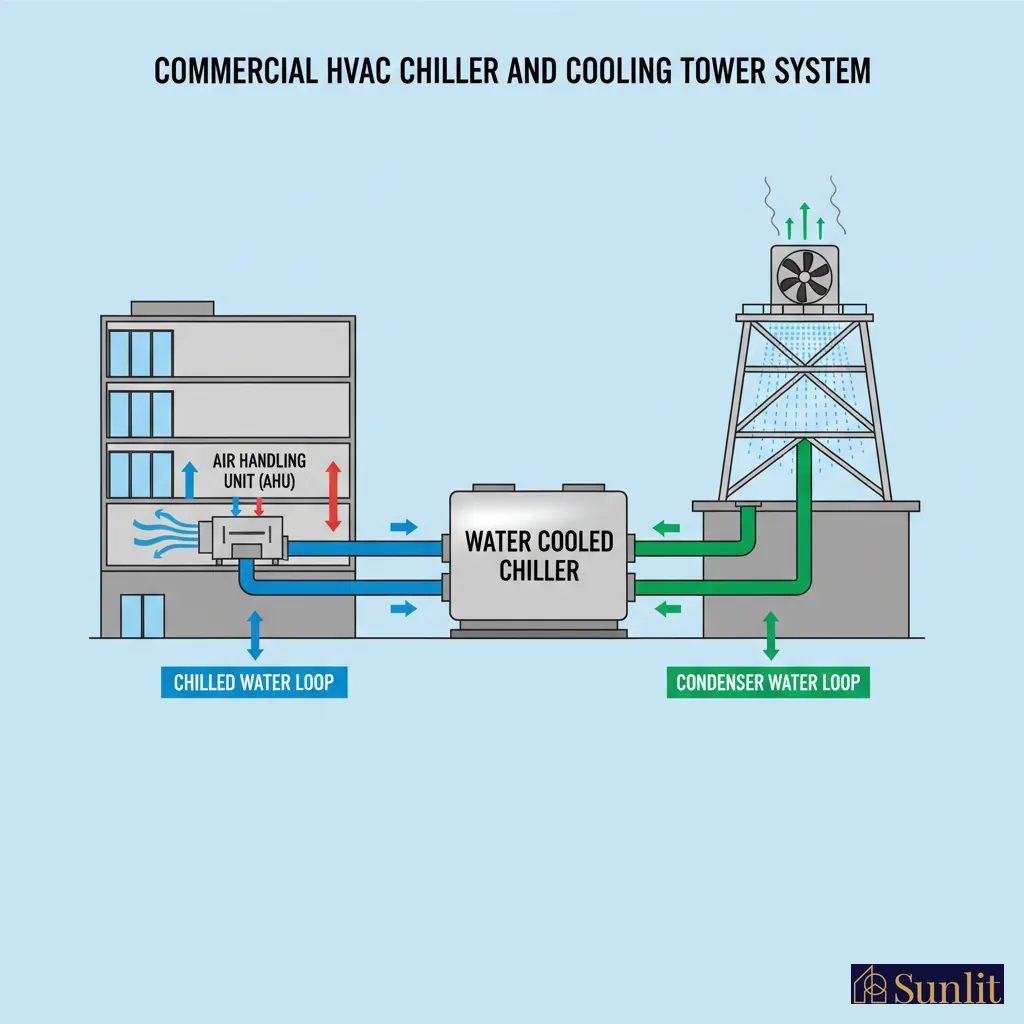
Instead of cooling air directly with refrigerant, large buildings use a chiller.
- The refrigeration cycle (in the chiller) cools down water to about $6^{\circ}\text{C}$ to $7^{\circ}\text{C}$ ($44^{\circ}\text{F}$).
- This “chilled water” is pumped through insulated pipes to various parts of the building.
- In the rooms, the water passes through an Air Handling Unit (AHU) or Fan Coil Unit (FCU). Air blows over the cold water pipes, cooling the room.
- The water warms up to about $12^{\circ}\text{C}$ ($54^{\circ}\text{F}$) and returns to the chiller to be cooled again.
Advantage:
Water is easier to pump over long distances than refrigerant gas.
4.2 Cooling Towers (Heat Rejection)
In a massive building, the heat extracted from the inside (plus the heat generated by the massive compressors) must be rejected. Air-cooled condensers (like home units) are often insufficient.
Commercial systems often use a Cooling Tower.
- The chiller produces hot water (carrying the building’s heat) on its condenser side.
- This hot water is pumped to a tower on the roof.
- The water is sprayed over a fill material while fans blow air upward.
- A small portion of the water evaporates. The Latent Heat of Vaporization is absorbed from the remaining water, cooling it down significantly.
- The cooled water returns to the chiller to absorb more heat.
4.3 VRF / VRV Systems
Variable Refrigerant Flow (VRF) is a bridge between residential and commercial. It uses one large outdoor unit connected to many indoor units.
- Technology: The compressor uses an inverter to vary its speed precisely.
- Efficiency: It sends only the exact amount of refrigerant needed to each indoor unit. One room can be off, another at 50%, and another at 100%. Some advanced VRF systems can even heat one room while cooling another by moving heat between them (Heat Recovery).
5. Industrial HVAC (Factories, Data Centers, Pharma)
Industrial HVAC differs from comfort cooling; it focuses on process control.
5.1 Precision and Load
- Data Centers: Computers generate massive heat. The HVAC must run 24/7/365. A failure can melt servers. These systems use “Precision Air Conditioning” (PAC) which controls humidity within $\pm 5%$ and temperature within $\pm 1^{\circ}\text{C}$.
- Pharmaceuticals: Requires strict air filtration. Systems use HEPA filters (High-Efficiency Particulate Air) to trap 99.97% of particles to prevent contamination.
5.2 Ventilation and Make-up Air
In factories with welding or chemical processes, bad air is constantly exhausted. If you pump air out, you must pump air in, or the building will implode (negative pressure).
- Make-up Air Units (MAU): These are massive fans that suck in fresh outdoor air, filter it, condition it (heat/cool), and force it into the building to replace exhausted air.
6. Engineering Efficiency: COP and EER
Engineers measure efficiency using the Coefficient of Performance (COP). It is the ratio of useful cooling provided to the work (electricity) required.
$$ \text{COP} = \frac{Q_{\text{cool}}}{W_{\text{in}}} $$
If a system has a COP of 3.5, it means for every $1,\text{kW}$ of electricity consumed, it moves $3.5,\text{kW}$ of heat energy. This is why heat pumps are so efficient—they don’t create heat (like a toaster); they just move it.
Summary Comparison Table
| Feature | Residential (Split/Window) | Commercial (Office/Mall) | Industrial (Factory) |
|---|---|---|---|
| Primary Medium | Refrigerant (DX) | Chilled Water / Refrigerant | Chilled Water / Glycol |
| Heat Rejection | Air-cooled (Fan) | Cooling Tower (Water) / Air | Cooling Tower / River water |
| Control Priority | Comfort (Temp) | Efficiency & Zoning | Process Safety & Precision |
| Ventilation | Minimal / Natural | Mechanical (AHU) | High Volume / Filtration |
| Complexity | Low | High | Very High |
Conclusion
From the small compressor humming outside your bedroom to the massive cooling towers atop skyscrapers, HVAC systems are essential for modern life. They rely on the manipulation of pressure and phase changes to pump heat against its natural flow, ensuring that regardless of the weather outside, the environment inside remains safe and comfortable.
Reference & Sources :
- Vapor-compression cycle stages (compression, condensation, expansion, evaporation): https://www.araner.com/blog/vapor-compression-refrigeration-cycle, https://en.wikipedia.org/wiki/Vapor-compression_refrigeration, https://bemcyclopedia.com/wiki/Understanding_the_vapor_compression_cycle
Residential split (DX) systems and dehumidification: https://superiorhomesupplies.com/blogs/news/how-does-an-hvac-split-system-work, https://aristotleair.com/dehumidification-in-hvac-systems/
Commercial chillers, cooling towers, VRF/VRV: https://starwaygroupbd.com/the-comparison-chiller-system-v-s-vrf-variable-refrigeration-flow-system-air-conditioning/, https://www.youtube.com/watch?v=sWJCWDpY9is, https://theengineeringmindset.com/how-cooling-towers-work/
Industrial precision cooling, HEPA filtration, make-up air: https://www.kl-telecom.com/news/what-is-precision-cooling-in-a-data-center.html, https://cleanair.camfil.us/2024/11/13/why-efficient-hvac-air-filtration-is-vital-for-pharmaceutical-manufacturing-the-key-to-suc…, https://www.stulz.com/en-in/products/detail/make-up-air-unit/
Efficiency (COP, EER): https://ecoair.org/pages/cop-and-eer
System comparisons: https://earnest.com.bd/the-difference-between-commercial-and-industrial-hvac-systems/
Frequently Asked Question
In Dhaka's crazy hot-humid days with 80-90% monsoon moisture, VRF systems shine—they zone cool exactly where needed, zap humidity fast, and cut energy bills by 20-30% for homes or shops. Way better than basic splits that struggle here.
Dhaka air hits 90% humidity causing mold everywhere; your AC's cold coils grab that moisture like dew on a chilled bottle, drain it out, and keep rooms fresh—no more sticky discomfort in our tropical mess.
For big Dhaka buildings, chillers pump chilled water everywhere efficiently—no hassle with long refrigerant lines—team them with rooftop cooling towers to dump heat, perfect for crowded commercial spots.
COP shows how much cooling you get per taka on electricity—like 3.5 means triple bang for buck moving heat smartly. Huge in Bangladesh with power hikes and outages; pick high COP for real savings.
At Sunlit, we weave HVAC right into Gulshan or Banani designs—sleek VRF/chillers hidden perfectly, tackling Dhaka humidity with engineering smarts so your space feels premium and comfy year-round.