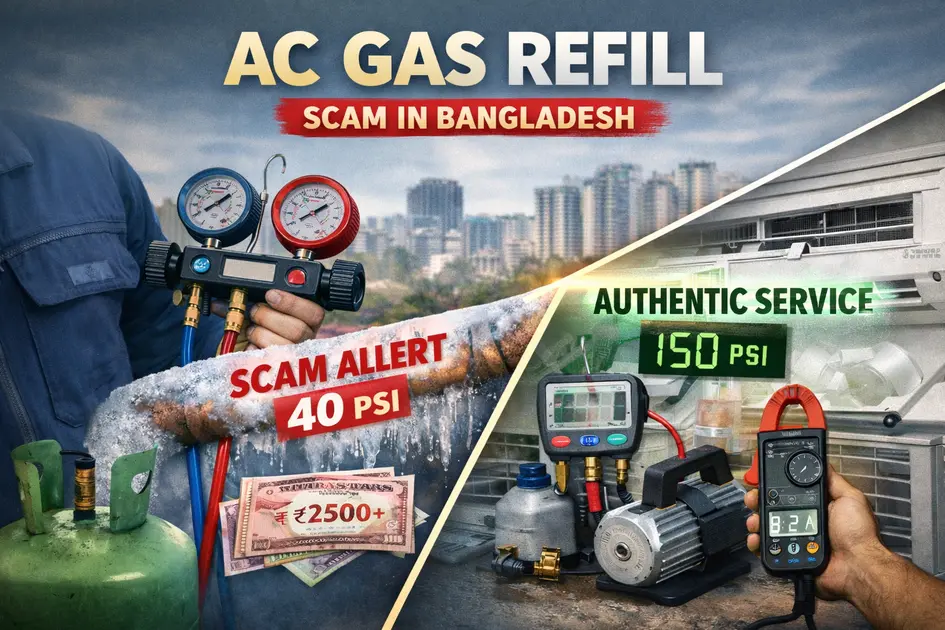
AC gas refill scam awareness graphic

Authentic AC Maintenance Protocols vs. AC gas refill scam in Dhaka

"The Core Truth : An air conditioner does not consume gas. Refrigerant circulates in a sealed closed-loop system. If gas is genuinely low, there must be a physical leak.What’s actually happening in most Dhaka homes is airflow restriction, not gas loss."

Table of Contents

Why Homeowners in Dhaka Are Repeatedly Told “Your AC Gas Is Low”

Across Dhaka, especially in high-density residential zones like Bashundhara R/A and Mirpur, many homeowners hear the same diagnosis after calling an AC technician:

Sir, gas low. Refill needed.


In most cases, this statement is technically false.

How the “Gas Leak” Deception Works (Local Technician Tactics Explained)

What Causes Reduced Cooling in Dhaka Homes?

  • Dust-heavy air (high PM2.5 levels)

  • Clogged indoor filters

  • Choked evaporator coils

  • Bent aluminum fins from improper washing

These conditions reduce heat exchange, making the room feel less cool—without any gas loss.

Untrained or dishonest technicians exploit this gap in homeowner knowledge.

The “PSI Bluff”: The Most Common AC Gas Scam

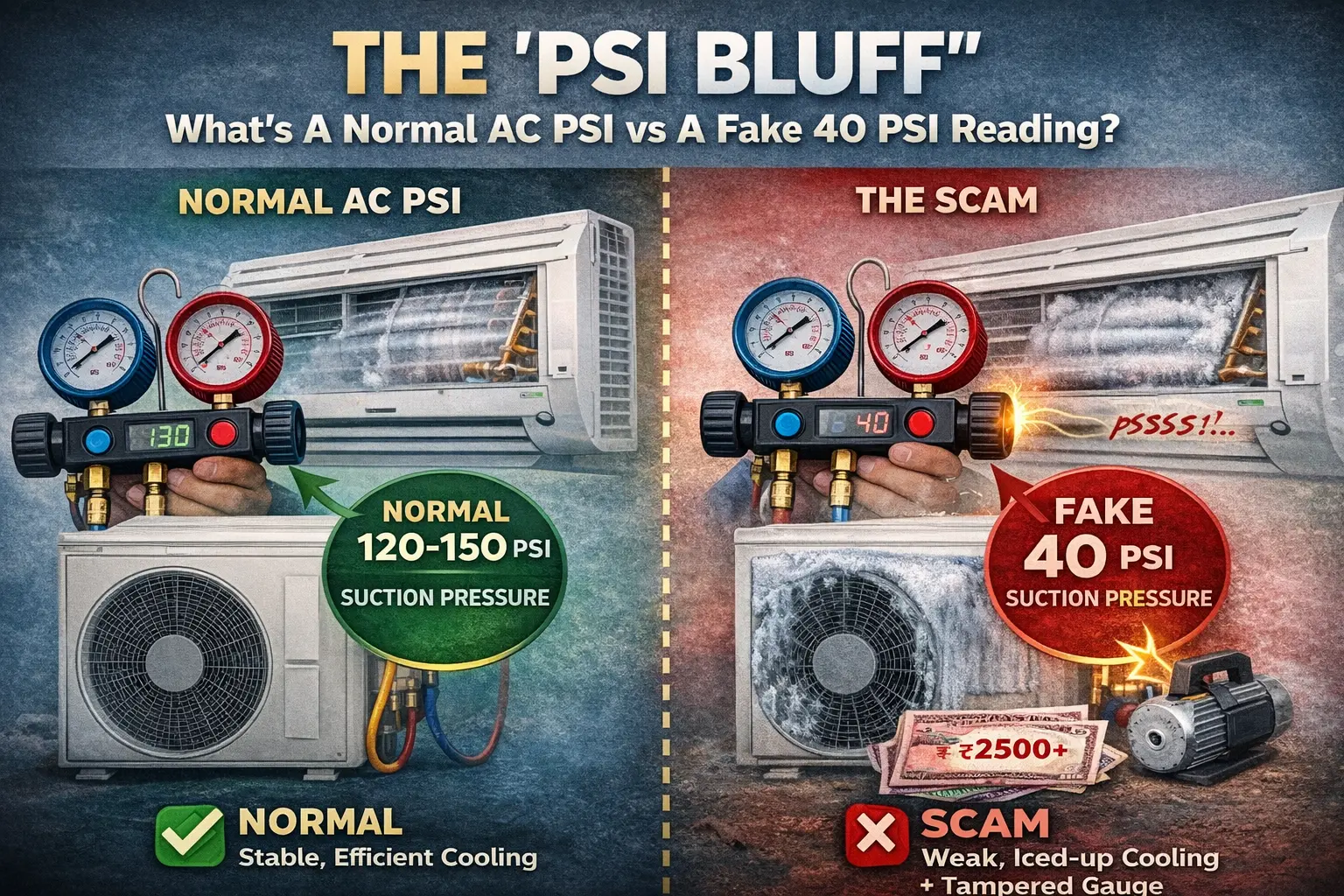
Comparison of normal AC R410a PSI readings (120–150 PSI) versus fake 40 PSI scam reading in Dhaka, showing suction/discharge lines, manifold gauge, and compressor health.
Spotting the “PSI Bluff”: How Dhaka technicians manipulate AC gas pressure readings to charge unnecessary refills. Learn correct PSI for R410a AC and avoid scams.

PSI is the pressure metric AC technicians use to diagnose refrigerant levels, and the scam exploits homeowners who don’t understand the numbers.

In the context of AC systems:

  • It measures refrigerant pressure inside the AC lines.

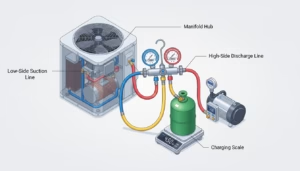
  • Technicians use a manifold gauge to read:

    • Suction line (low pressure)

    • Discharge line (high pressure)

How the Scam Is Performed

  • A manual manifold gauge is attached

  • The service valve is slightly loosened

  • A hissing sound is created to simulate leakage

  • The gauge shows a deliberately low pressure reading

The Lie You’re Told

“Pressure only 40 PSI. If you don’t refill now, compressor will burn.”


The Technical Reality

  • A healthy R410a inverter AC typically shows:

    • 120–150 PSI suction pressure during normal operation

  • At 40 PSI, the system would:

    • Ice up rapidly

    • Trigger compressor overload protection

    • Shut down—not “cool slightly less”

Voltage Fluctuation Is Not a Gas Problem (Critical Dhaka Insight)

In neighborhoods like Dhanmondi and Mohakhali DOHS, frequent load-shedding causes:

  • PCB failure

  • Capacitor damage

  • Inverter drive faults

What Technicians Claim

“Low gas pressure damaged PCB.”


Why This Is Incorrect

  • Refrigerant does not degrade due to voltage

  • Electrical instability damages electronics, not gas

  • Without a punctured copper line, gas levels remain stable 10+ years

Authentic AC Maintenance Protocols (What Real Engineers Do)

Certified HVAC engineers follow diagnostics first, gas last.

1. Ampere (Current) Draw Test — Always First

Before touching any gas valve, current is measured.

Expected Values

  • 1.5 Ton Non-Inverter: 7.5 – 8.5 Amps

  • 1.5 Ton Inverter: Variable (checked under max load)

Immediate Red Flag

  • Technician skips amp testing and reaches for the gas wrench


2. Leak Confirmation Before Any Gas Work

  • Visual inspection of copper lines

  • Nitrogen pressure testing (not soap guessing)

  • Only after confirmed leakage → repair


3. Vacuuming Is Mandatory After Leak Repair

If gas is added without vacuuming, long-term damage is guaranteed.

Why Vacuuming Matters
  • Removes moisture and air

  • Prevents formation of hydrofluoric acid

  • Protects compressor windings

Real-World Consequence

Post-service compressor failure is common in commercial units across Uttara and Gulshan due to skipped vacuuming.

Technical Cost Matrix: Scam Pricing vs. Engineering Standard (Bangladesh)

Service TypeTypical Local Price (High Scam Risk)Authentic Engineering PriceMandatory Technical Protocol
General Service500 – 800 BDT1,200 – 1,500 BDTJet wash, fin straightening, ampere check
Gas Top-Up1,800 – 2,500 BDT350 – 500 BDT per PSIOnly after confirmed leak repair
Full Gas Refill3,500 – 4,500 BDT4,500 – 6,000 BDTLeak repair + deep vacuuming
Capacitor Replacement1,200 – 1,500 BDT450 – 650 BDTExact µF rating match
Master Service~1,500 BDT2,500 – 3,000 BDTFull indoor unit dismantling

Seasonal AC Risks in Bangladesh (Monsoon & Winter)

Why AC Smells During Monsoon

  • Average humidity exceeds 80%

  • Moisture forms bio-film on evaporator coils

  • Odor is mistaken for gas leakage


When Chemical Wash Is Necessary

  • Pre-monsoon servicing

  • Mold or bacterial growth present

  • Cooling reduced despite clean filters

Common Technician Mistake

  • High-pressure water jets

  • Bent fins → permanent airflow loss

Engineering-Safe Method

  • Low-pressure alkaline foam cleaner

  • Preserves coil geometry

  • Maintains heat transfer efficiency

  • Aligns with Bangladesh National Building Code ventilation intent

Professional AC Diagnostics in Dhaka

At Sunlit Architect, AC servicing is treated as mechanical diagnostics, not guesswork.

  • Digital manifold gauges

  • Clamp meter diagnostics

  • Mandatory vacuuming

  • Gas charged per PSI—not flat lies

FAQs: AC Gas & Technician Scam

1. Does an air conditioner actually run out of gas?

Answer: No. Refrigerant is sealed in a closed loop and doesn’t evaporate or “finish” with use. If the gas is lower than expected, it means there is a physical leak, not consumption over time. Certified leak proofing + tests must come first before any refill discussion.


2. How can I tell at home if my AC truly needs gas?

Answer: Run your AC on cool for 15–20 minutes. If the coils are frosting, there’s airflow blockage or moisture—not necessarily low gas. If cooling is poor but pressures are normal, adding gas solves nothing. Only a proper digital pressure read + leak detection can confirm true low refrigerant.

3. Why do roadside technicians always insist on gas refills?

Answer: Many local techs lack proper leak detection tools and use pressure bluffs (artificial low PSI sounds) to convince you gas is low. This upsells unnecessary refills. A real engineer tests electrical load and true leak points first.

 4. Is it a scam if a technician says you need gas every few months?

Answer: Yes — AC refrigerant does not deplete on repeated cycles. If someone tells you gas needs refilling every season or every few months, it’s almost certainly inaccurate service advice and likely a scam pattern.

5. What are the real technical checks before charging gas?

Answer: Always ask these diagnostics:

  • Ampere (current) test

  • Digital pressure trace on suction and discharge lines

  • Electronic leak detection (nitrogen or ultrasonic)

  • Verified leak location before any gas is added


6. Why do some ACs cool poorly even after recent service?

Answer: Poor airflow, dirty filters, bent fins, moisture on coils, or electrical faults (PCB/capacitor), not gas levels, are the most common causes. Even basic news guides point out these top-5 cooling issues that get misinterpreted as gas problems.

7. Can a technician deliberately leak gas to charge more?

Answer: Sadly, yes. Some scam technicians open valves or release refrigerant to create a false “low pressure” signal so they can charge for gas refills. Always insist on measurable pressure data before and after any work.

8. How much gas should cost when legitimately required?

Answer: Real engineers charge per PSI of gas added after leak verification and vacuum process — not flat refill pricing. Resorts to flat refill without diagnostics is a red flag.

Example: Transparent pricing for R410A / R32 should reference PSI added, not a bulk “refill” cost.


9. If my AC just isn’t cooling, does it always mean gas is low?

Answer: No. Common symptoms like warm air, ice buildup, or compressor cycling can be due to:

  • Dirty coils/filters

  • Blocked airflow

  • Electrical faults

Reduced cooling does not automatically mean gas loss — this is one of the major misconception points leading to scams.

10. Can I test refrigerant level myself before calling a technician?

Answer: You can do basic observation (ice on coils, noise, airflow weakness), but real pressure testing requires tools. The safest option is a professional leak diagnosis with a digital manifold gauge before any gas is added.

12. Sunlit’s safety promise — what extra checks do we do?

Answer:
✔ Digital leak test & documentation
✔ Electrical amp-load verification
✔ Vacuuming before refill
✔ True PSI pressure comparison
✔ Leak repair before charging gas
This prevents damage — unlike generic roadside services.

Stop paying for “ghost gas.”

Book a forensic AC inspection and know exactly what your system needs—nothing more, nothing fake.

Related Posts