Advanced AC Service and Maintenance in Dhaka : 40+ Years of Professional HVAC Expertise

In Dhaka, AC units require a 3-phase seasonal maintenance cycle to combat 90% humidity and high PM2.5 dust levels. Phase 1 (Feb–March): Pre-summer Master Jet Wash. Phase 2 (June–Oct): Monsoon drainage and mold protection. Phase 3 (Nov–Jan): Winter audit and R-32 refrigerant retrofitting. Following these BNBC 2020 compliant protocols in AC service and maintenance can reduce energy consumption by 30% and extend equipment life to 15+ years.

Table of Contents

Beyond Repair: Managing Your AC as a High-Value Asset

From the high-rises of Gulshan to the smart city plots of Purbachal, an AC is not just an appliance; it is a high-value asset for you. With 40+ years of engineering experience, we know that a “break-fix” mindset is a financial drain.

According to BNBC 2020, proper Ac service and maintenance is now a regular necessity. In a dense city like Dhaka, where humidity hits up to 90% and PM2.5 dust levels are among the highest globally, your system works 40% harder than intended. 

Managing an HVAC asset involves a transition from “reactive repair” to a structured lifecycle strategy that protects the Return on Investment (ROI) of units that cost upwards of 60,000 to 500,000 BDT.

The Dhaka Challenge: Dust and Humidity

Dhaka’s environment creates two unique “killers” for HVAC systems:

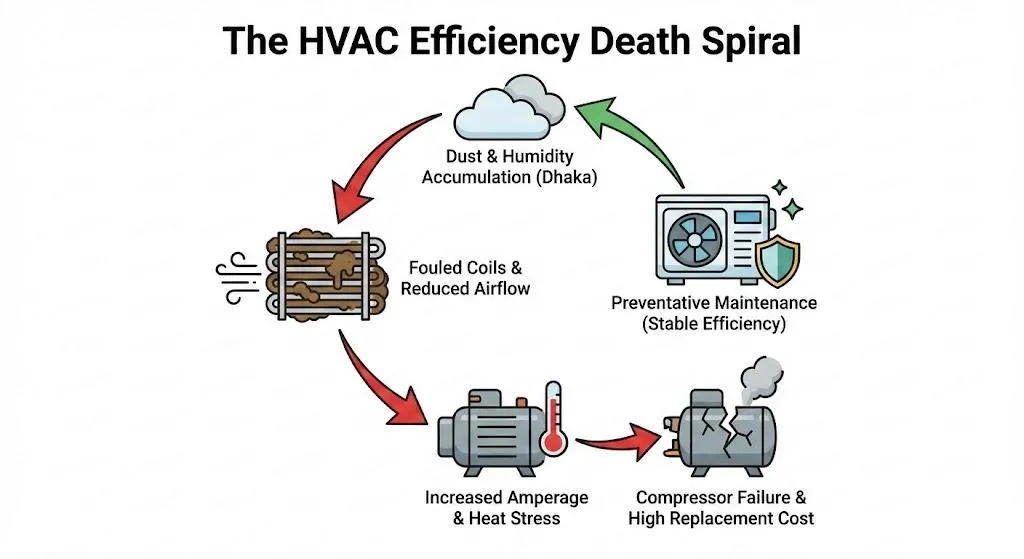
  • The “Jelly” Sludge: High monsoon humidity reacts with indoor dust to create a biological slime in drainage pipes—the #1 cause of indoor leaking.


  • Dhaka Dust (PM2.5): Fine particles in areas like Uttara and Bashundhara clog condenser fins, causing “thermal choking” and premature compressor burnout.
Diagram illustrating the HVAC efficiency death spiral, showing how dust and humidity lead to fouled coils, increased amperage, and ultimately compressor failure, contrasted with preventative maintenance.
Understanding the HVAC Efficiency Death Spiral and the importance of preventative maintenance to avoid costly failures.

Seasonal Maintenance Roadmap: The 3-Phase Engineering Cycle

Dhaka’s environmental stressors are unique. The high concentration of Particulate Matter (PM2.5) in areas like Uttara and Bashundhara causes rapid clogging of condenser fins. Simultaneously, the city’s 80-90% monsoon humidity leads to “jelly” formation in drainage pipes—the primary cause of internal water leakage. Without professional Jet Washing, these factors force compressors to work 40% harder, leading to premature burnout.

To ensure a 15–20 year service life, Sunlit Architect recommends a schedule aligned with Dhaka’s tropical climate shifts.

Phase 1: Pre-Summer Peak Performance (February – March)

This is the “Golden Window.” A professional Master Jet Wash now prevents 90% of mid-summer emergency breakdowns.

  • The Technical Edge: We don’t just rinse with water. We use pH-neutral, non-acidic foaming cleaners to lift organic particulates without damaging the aluminum fins.

  • Precision Tuning: We check the Energy Efficiency Ratio (EER) to ensure your unit meets BNBC standards before the heatwave hits.

Phase 2: Monsoon Protection & Drainage Protocols (June – October)

High humidity creates “sludge” in the drain pan.

  • Drainage Management: We clear the biological slime to prevent indoor dripping and mold growth.

  • Anti-Corrosion: We inspect Outdoor Units (ODUs) for rust. In high-density areas, urban pollutants accelerate metal decay.

Phase 3: Winter Deep Audit and Retrofitting (November – January)

As usage drops, we focus on technical modernization and Asset Grading.

  • The 500-Micron Standard: If a system needs a recharge, we evacuate it to below () to remove all moisture. This is critical for the health of your compressor’s lubricant.

  • Inverter Health: We check VFD (Variable Frequency Drive) harmonics and capacitor integrity. Dhaka’s voltage fluctuations often damage these expensive power electronics.

  • Refrigerant Shift: We help you move from the old R-22 gas to R-32, which is 20% more efficient and significantly more eco-friendly.

Strategic Asset Management: Grading Your Units

We help facility managers move from “Reactive Scrambling” to “Planned Upgrades” using our grading system:

  • Grade A: High efficiency. Regular preventative care.

  • Grade B: Mid-life. Requires proactive part replacement (fan motors/contactors) to prevent total failure.

  • Grade C: End-of-life (8–10 years). We maximize residual life while you budget for the next capital expenditure (CapEx).

2026 Dhaka Market Pricing & Compliance

Service ComponentStandard Split (1.5 – 2 Ton)Commercial (VRF/Chiller)Frequency2026 Est. Price (BDT)
Basic ServicingFilter & Body CleanIDU InspectionEvery 3 Months1,200 – 1,800
Master Jet WashDeep Chemical CleanSystem-wide WashAnnually3,000 – 5,000
Gas Charge (R-32)Full RechargePer KG LoadAs Required4,000 – 6,000
High-Rise InstallAbove 8th FloorSpecialized MountOne-time3,500 – 10,000

Advanced Technical Protocols: The Sunlit Standard of 40 Years of Expetise

Sunlit goes beyond ac service and maintenance, like we never do simple “wash.” Our technical framework ensures your Inverter technology actually saves you money:

Advanced AC Service and Maintenance in Dhaka : 40+ Years of Professional HVAC Expertise
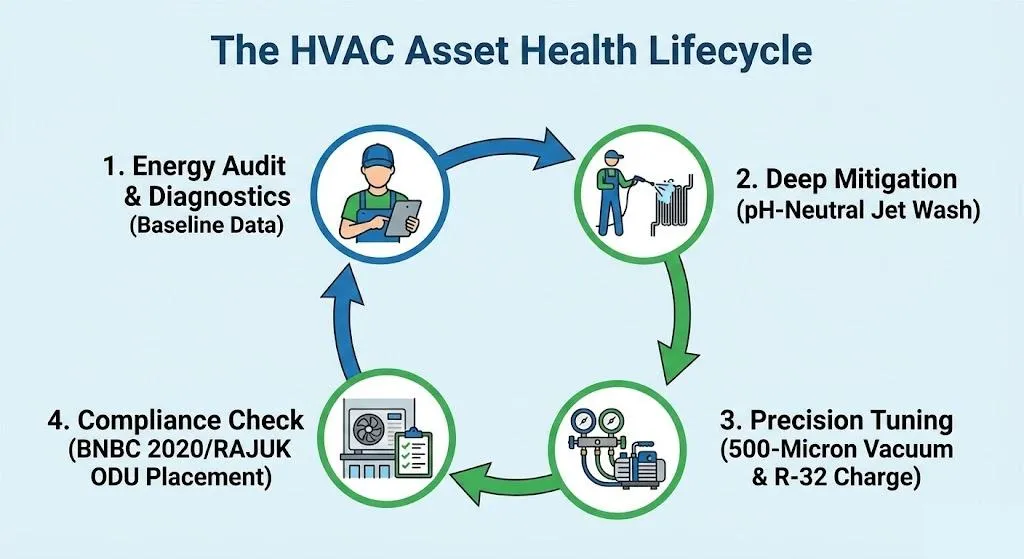
A comprehensive overview of the HVAC Asset Health Lifecycle, from energy audits to compliance checks, ensuring optimal performance and longevity.
  • Precision Vacuuming: We evacuate systems to below 500 microns (standard -30 psi) before charging. This removes moisture that otherwise turns into acid inside your compressor.

  • Inverter VFD Health: We check Harmonic Distortion and DC bus capacitors for bulging. This protects the expensive power electronics that make Inverter ACs energy-efficient.

  • Chemical Jet Wash: We use pH-neutral, non-acidic foaming cleaners. Standard acid cleaning “brightens” the coils but eats away the aluminum fins, reducing heat transfer over time.

Strategic Asset Grading

We categorize your inventory to manage your Total Cost of Ownership (TCO):

  • Grade A: High efficiency. Standard preventative maintenance.

  • Grade B: Mid-life. Requires proactive component replacement (fan motors/contactors) to avoid peak-summer failure.

  • Grade C: End-of-life (8–10 years in Dhaka). We focus on maximizing residual life while you plan your next CapEx cycle.

Frequently Asked Question

Why is my Inverter AC bill still high?

If not vacuumed to 500 microns or if coils are fouled by “Dhaka Dust,” the inverter cannot modulate properly. It runs at max amperage, defeating the energy-saving purpose.


What are the RAJUK rules for outdoor units? Per the DAP 2022-2035, ODUs must be on designated ledges. Hanging them over public sidewalks is a safety violation. Proper placement also improves efficiency by 10% by avoiding direct afternoon sun.


How does Sunlit handle leaks? We never just “top up.” We use electronic leak detectors (3g/year sensitivity) and UV dyes. We fix the source, then recharge by weight as per manufacturer specs.

Free Consultation

Protect your investment. Don’t let Dhaka’s dust destroy your ROI. Contact Sunlit Architect today for a BNBC-compliant HVAC Audit. Call: +8801784385335

Related Posts