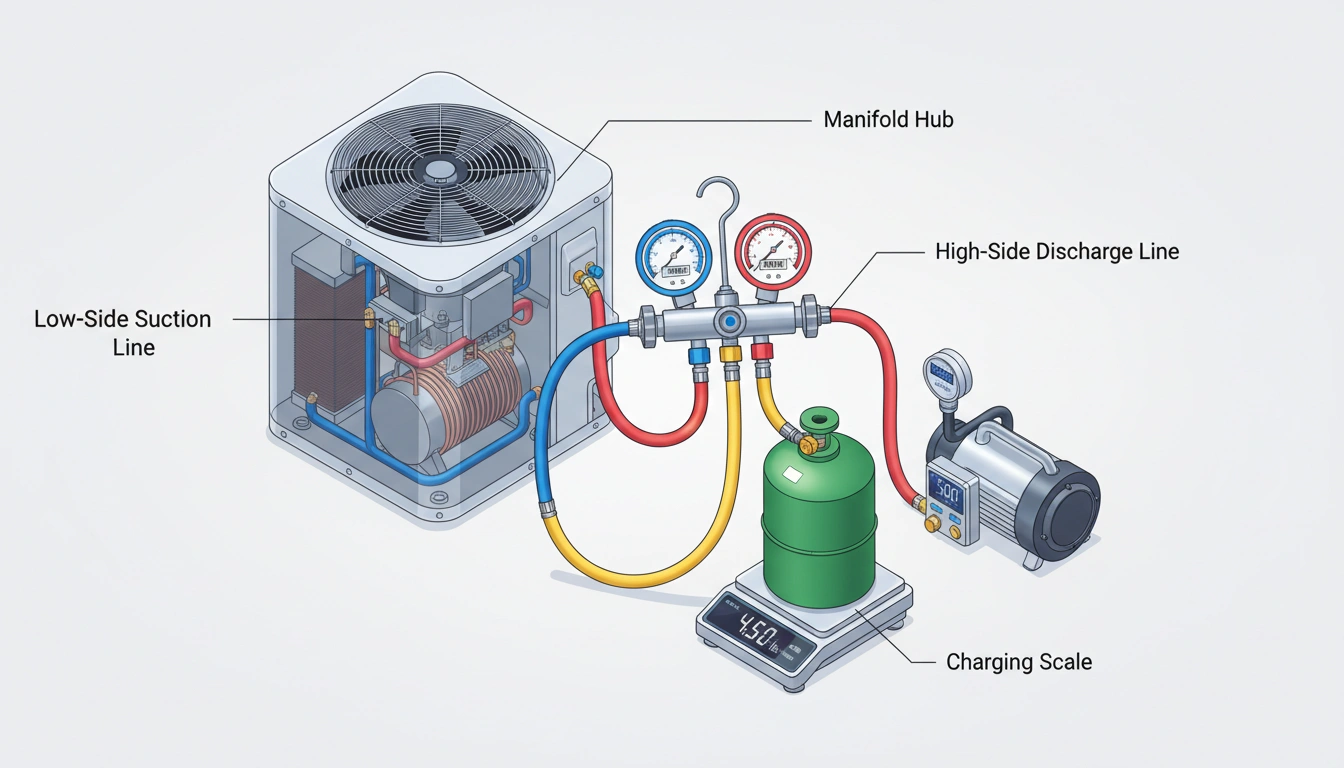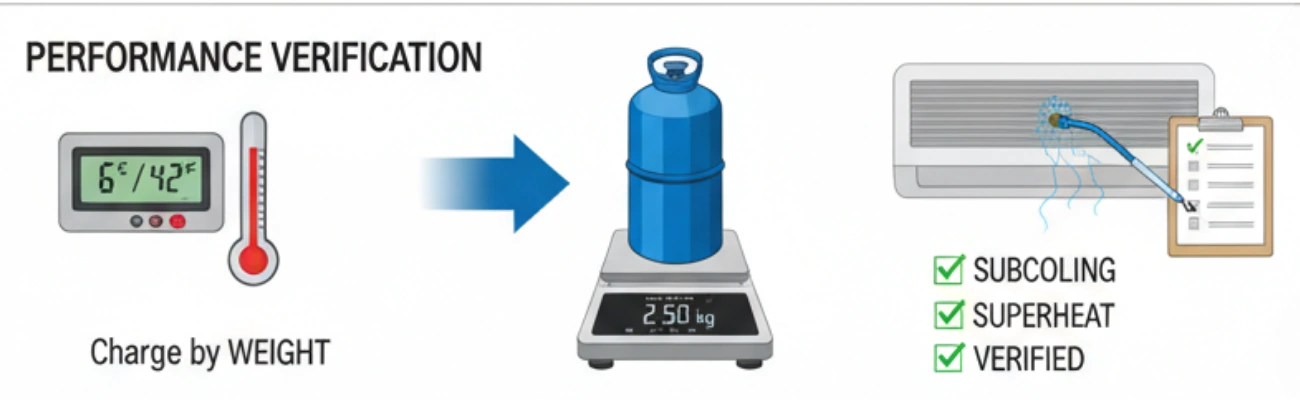
HVAC Refrigerant Charging and System Evacuation infographic

Optimization of Refrigerant Charging and System Evacuation in HVAC Systems

Abstract

This paper investigates the critical procedures of system evacuation and refrigerant charging (commonly known as AC gas filling). It explores the thermodynamic necessity of removing non-condensables and moisture to ensure system longevity and efficiency. The study outlines the technical workflow, diagnostic indicators for recharging, and the mechanical implications of improper servicing.

Facebook
Twitter
LinkedIn

Table of Contents

1. Introduction to System Evacuation

Before any refrigerant is introduced into an Air Conditioning (AC) system, the internal environment must be cleared of atmospheric air and moisture. This process, known as evacuation or “pulling a vacuum,” is essential for maintaining the chemical stability of the refrigerant and the compressor oil.

Definition: Evacuation

In the context of HVAC, evacuation is the process of using a vacuum pump to remove air, moisture, and other non-condensable gases from a sealed refrigerant system before charging it with new refrigerant. This ensures optimal system performance and longevity.

Why it is necessary: Atmospheric air contains non-condensables (like Nitrogen and Oxygen) and water vapor. These elements can have detrimental effects on the HVAC system.
 
Consequences of failure: Moisture reacts with refrigerants to form hydrofluoric or hydrochloric acids, leading to acid sludge that corrodes the compressor windings and clogs the expansion valve. Non-condensable gases increase system pressure, leading to reduced efficiency and increased wear on components.
Research Paper: Optimization of Refrigerant Charging and System Evacuation in HVAC Systems
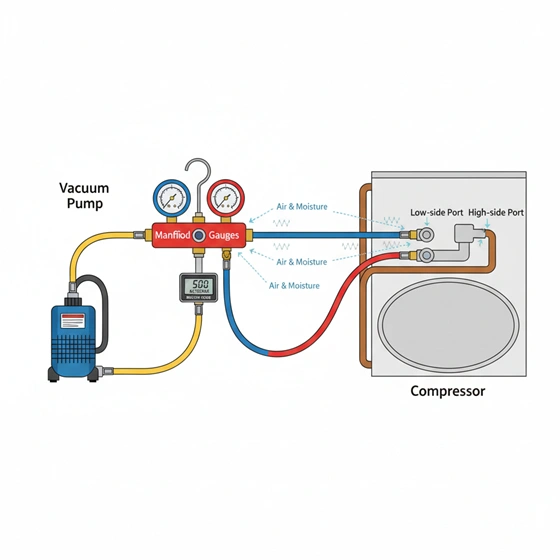
Figure 1: Detailed setup of an HVAC vacuum pump and manifold gauges for system evacuation, highlighting the removal of air and moisture
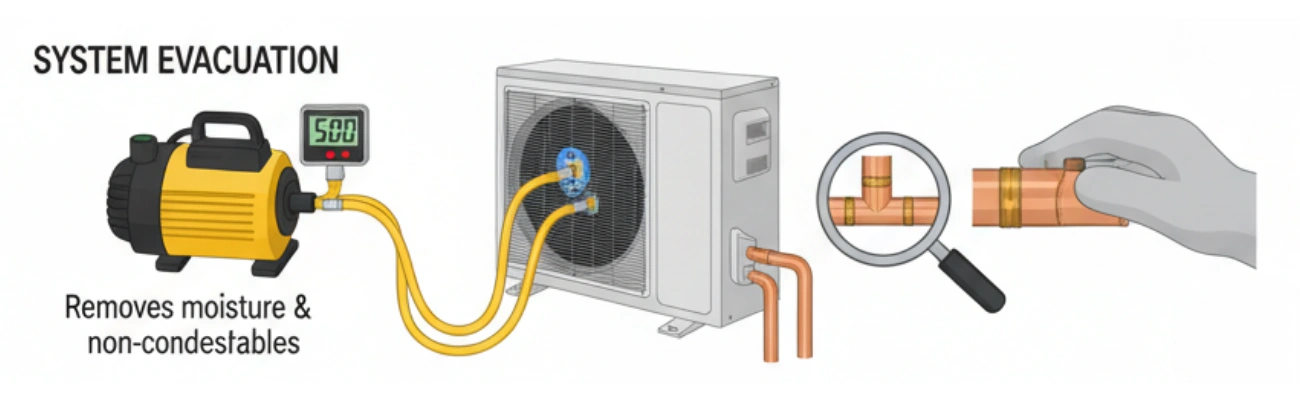
HVAC system evacuation process
Figure 2: The system evacuation process, showing the removal of moisture and noncondensables using a vacuum pump

2. The Mechanism of Gas Filling (Refrigerant Charging)

Refrigerant charging is the process of adding a specific mass of chemical cooling
agent (e.g., R-32, R-410A) into the refrigeration cycle. This precise procedure is crucial
for the efficient operation of the HVAC system. [3]

Definition: Refrigerant Charging

Refrigerant charging refers to the process of accurately adding the correct amount of refrigerant into an HVAC system. This is
typically done by weight to ensure optimal performance and avoid under- or overcharging.

When it is needed:
  • Leakage: The most common cause, often occurring at flared joints or evaporator
    coils, leading to a loss of refrigerant.

  • Component Replacement: After replacing a compressor, filter drier, or tubing,
    the system must be recharged to its specified levels.

  • Initial Installation: For split systems where the line set length exceeds the
    factory pre-charge, additional refrigerant may be required.
Why it causes failure if neglected:

Low refrigerant levels lead to a drop in suction pressure, causing the evaporator to freeze and the compressor to overheat due to insufficient cooling from the return gas. Conversely, overcharging can lead to excessively high pressures, reducing efficiency and potentially damaging the compressor.

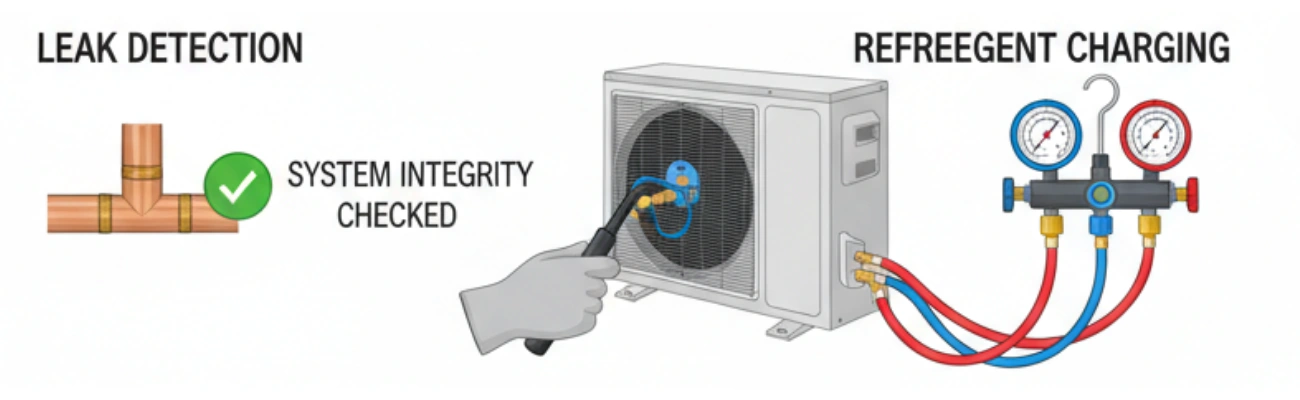
Image showing leak detection on HVAC piping and refrigerant charging using manifold gauges connected to an AC unit.
Figure 3: Leak detection and the process of charging the system with refrigerant using manifold gauges.

3. Technical Workflow: Step-by-Step Service

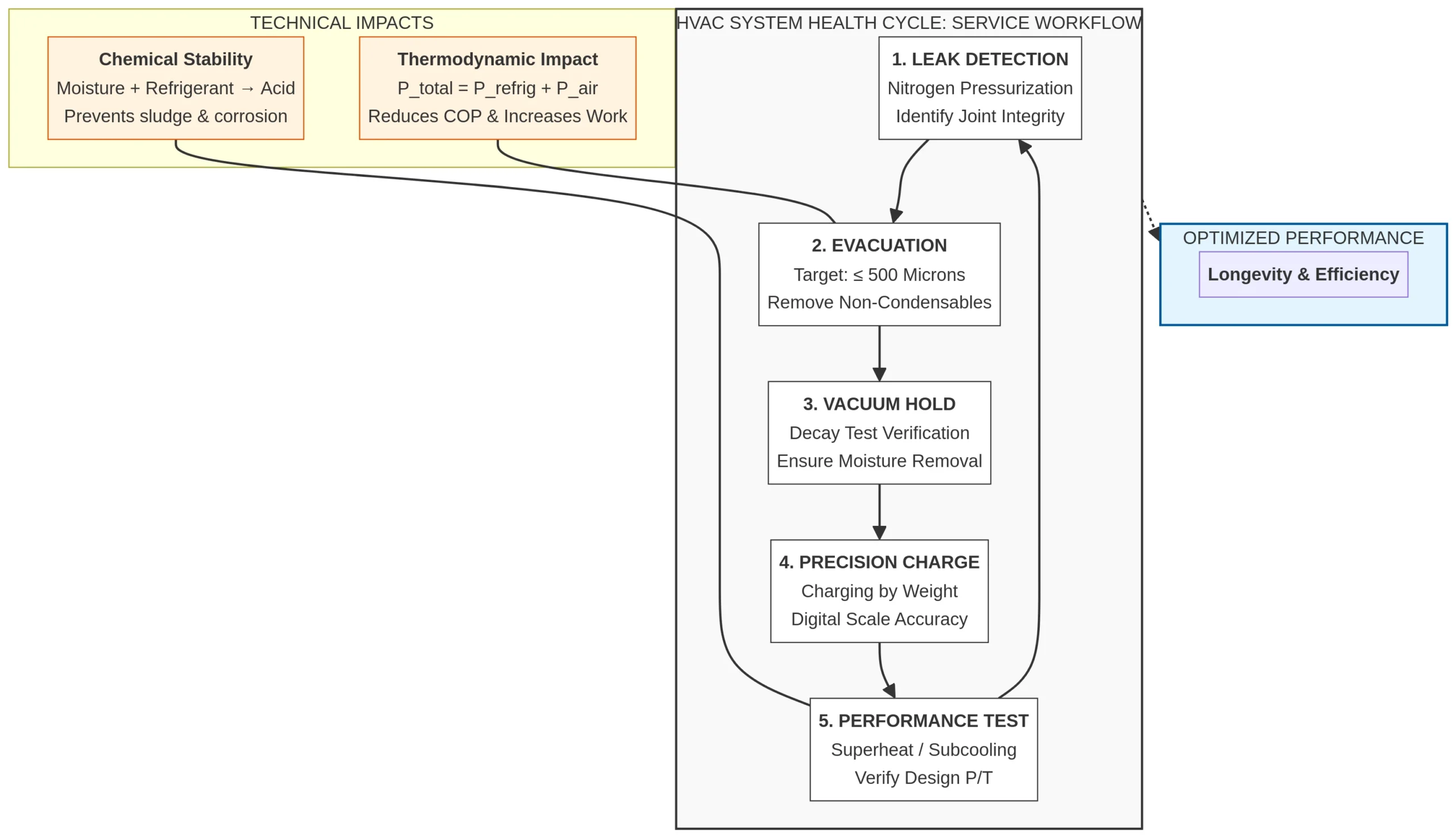
The following flowchart provides a high-level overview of the standard service
workflow for HVAC systems, ensuring a systematic approach to maintenance and
repair.

Detailed flowchart outlining the HVAC system health cycle service workflow, including leak detection, evacuation, vacuum hold, precision charge, and performance test.
Figure 4: A flowchart illustrating the cyclical nature of HVAC system maintenance, from leak detection to performance testing.

1. Leak Detection: Before filling, the system must be pressurized with dry Nitrogen to identify leaks using soapy water or electronic detectors. This critical step prevents refrigerant loss and ensures system integrity.

2. Evacuation:
Connect a high-cfm vacuum pump to thoroughly remove air and moisture. Monitor using a micron gauge to ensure proper vacuum levels are achieved.

Target: ≤ 500 microns to ensure all moisture has boiled off at room
temperature, preventing acid formation and corrosion. [4]


3. Charging by Weight:
Use a digital charging scale for precise measurement of refrigerant.
Refer to the manufacturer’s nameplate for the exact weight (e.g., 1.2kg) of
refrigerant required.

Note: Charging by weight is more accurate than charging by pressure due to
ambient temperature variables, which can significantly affect pressure
readings.

Diagram showing the setup of an HVAC vacuum pump connected to an AC compressor with manifold gauges, illustrating the removal of air and moisture.
Figure 5: Detailed setup of an HVAC vacuum pump and manifold gauges for system evacuation, highlighting the removal of air and moisture.

4. Key Components Involved

The following table describes the primary hardware involved in the evacuation and
gas-filling process, highlighting their function in ensuring a healthy HVAC system:

Component

Function in Service

Compressor

The heart of the system; circulates refrigerant and requires pure oil and no acid for efficient operation.

Manifold Gauge

Measures pressures (P_low and P_high) during charging and evacuation, providing critical diagnostic information.

Service Valves

Access points for the technician to interface with the sealed system for evacuation, charging, and pressure checks.

Filter Drier

Removes trace moisture and contaminants from the refrigerant, and must be replaced if the system was open to air.

5. Thermodynamic Analysis of Non-Condensables

Non-condensables, such as air and nitrogen, collect in the condenser, reducing the effective surface area for heat exchange. This phenomenon has several adverse thermodynamic consequences: [5]

  • Increased discharge pressure (P_d): The compressor has to work harder to overcome the additional pressure exerted by non-condensables.
  • Higher compression ratio (P_d / P_s): This leads to increased stress on the compressor and reduced efficiency.
  • Increased power consumption (W_comp): More energy is required to operate the system, resulting in higher utility bills.

The relationship between pressure and temperature for a pure refrigerant is governed by the Saturation Curve. If air is present, the total pressure follows Dalton’s Law of Partial Pressures:

P_total = P_refrigerant + P_air

Definition of Saturation Curve :

The saturation curve represents the relationship between the pressure and temperature at which a substance (like refrigerant) can exist as both a liquid and a vapor in equilibrium. It is crucial for understanding refrigerant behavior.

Dalton’s Law of Partial Pressures :

This law states that in a mixture of non-reacting gases, the total pressure exerted is equal to the sum of the partial pressures of the individual gases. In HVAC, this means air in the system adds to the refrigerant’s pressure.

This “extra” pressure forces the compressor to work harder, significantly reducing the Coefficient of Performance (COP). [6]

Definition: Coefficient of Performance (COP)

The COP of an HVAC system is a measure of its energy efficiency, defined as the ratio of useful heating or cooling provided to the work (energy) required to achieve it. A higher COP indicates greater efficiency and lower operating costs.

6. Conclusion

AC gas filling is not merely “topping up” a fluid; it is a precision procedure requiring the total removal of contaminants. Proper evacuation to 500 microns and charging by weight are the industry standards for ensuring high energy efficiency and preventing premature compressor failure. Adhering to these best practices ensures the longevity and optimal performance of HVAC systems, benefiting both the environment and consumers through reduced energy consumption and maintenance costs.

References


[1] ASHRAE Standard 15-2019, Safety Standard for Refrigeration Systems.
[2] ACCA Manual S, Residential Equipment Selection.
[3] EPA Section 608 Certification Program for Refrigerant Technicians.
[4] ACCA Manual J, Residential Load Calculation.
[5] Cengel, Y. A., & Boles, M. A. (2019). Thermodynamics: An Engineering Approach.
McGraw-Hill Education.
[6] ANSI/AHRI Standard
210
⁄240
, Performance Rating of Unitary Air-Conditioning and
Air-Source Heat Pump Equipment.

Related Posts